


All Article Properties:
{
"access_control": false,
"status": "publish",
"objectType": "Article",
"id": "49840",
"signature": "Article:49840",
"url": "https://staging.dailymaverick.co.za/article/2014-08-11-the-buffalo-prince-and-the-marikana-commission/",
"shorturl": "https://staging.dailymaverick.co.za/article/49840",
"slug": "the-buffalo-prince-and-the-marikana-commission",
"contentType": {
"id": "1",
"name": "Article",
"slug": "article"
},
"views": 0,
"comments": 0,
"preview_limit": null,
"excludedFromGoogleSearchEngine": 0,
"title": "The Buffalo Prince and the Marikana Commission",
"firstPublished": "2014-08-11 23:30:59",
"lastUpdate": "2014-08-11 23:30:59",
"categories": [
{
"id": "29",
"name": "South Africa",
"signature": "Category:29",
"slug": "south-africa",
"typeId": {
"typeId": "1",
"name": "Daily Maverick",
"slug": "",
"includeInIssue": "0",
"shortened_domain": "",
"stylesheetClass": "",
"domain": "staging.dailymaverick.co.za",
"articleUrlPrefix": "",
"access_groups": "[]",
"locale": "",
"preview_limit": null
},
"parentId": null,
"parent": [],
"image": "",
"cover": "",
"logo": "",
"paid": "0",
"objectType": "Category",
"url": "https://staging.dailymaverick.co.za/category/south-africa/",
"cssCode": "",
"template": "default",
"tagline": "",
"link_param": null,
"description": "Daily Maverick is an independent online news publication and weekly print newspaper in South Africa.\r\n\r\nIt is known for breaking some of the defining stories of South Africa in the past decade, including the Marikana Massacre, in which the South African Police Service killed 34 miners in August 2012.\r\n\r\nIt also investigated the Gupta Leaks, which won the 2019 Global Shining Light Award.\r\n\r\nThat investigation was credited with exposing the Indian-born Gupta family and former President Jacob Zuma for their role in the systemic political corruption referred to as state capture.\r\n\r\nIn 2018, co-founder and editor-in-chief Branislav ‘Branko’ Brkic was awarded the country’s prestigious Nat Nakasa Award, recognised for initiating the investigative collaboration after receiving the hard drive that included the email tranche.\r\n\r\nIn 2021, co-founder and CEO Styli Charalambous also received the award.\r\n\r\nDaily Maverick covers the latest political and news developments in South Africa with breaking news updates, analysis, opinions and more.",
"metaDescription": "",
"order": "0",
"pageId": null,
"articlesCount": null,
"allowComments": "1",
"accessType": "freecount",
"status": "1",
"children": [],
"cached": true
}
],
"content_length": 10723,
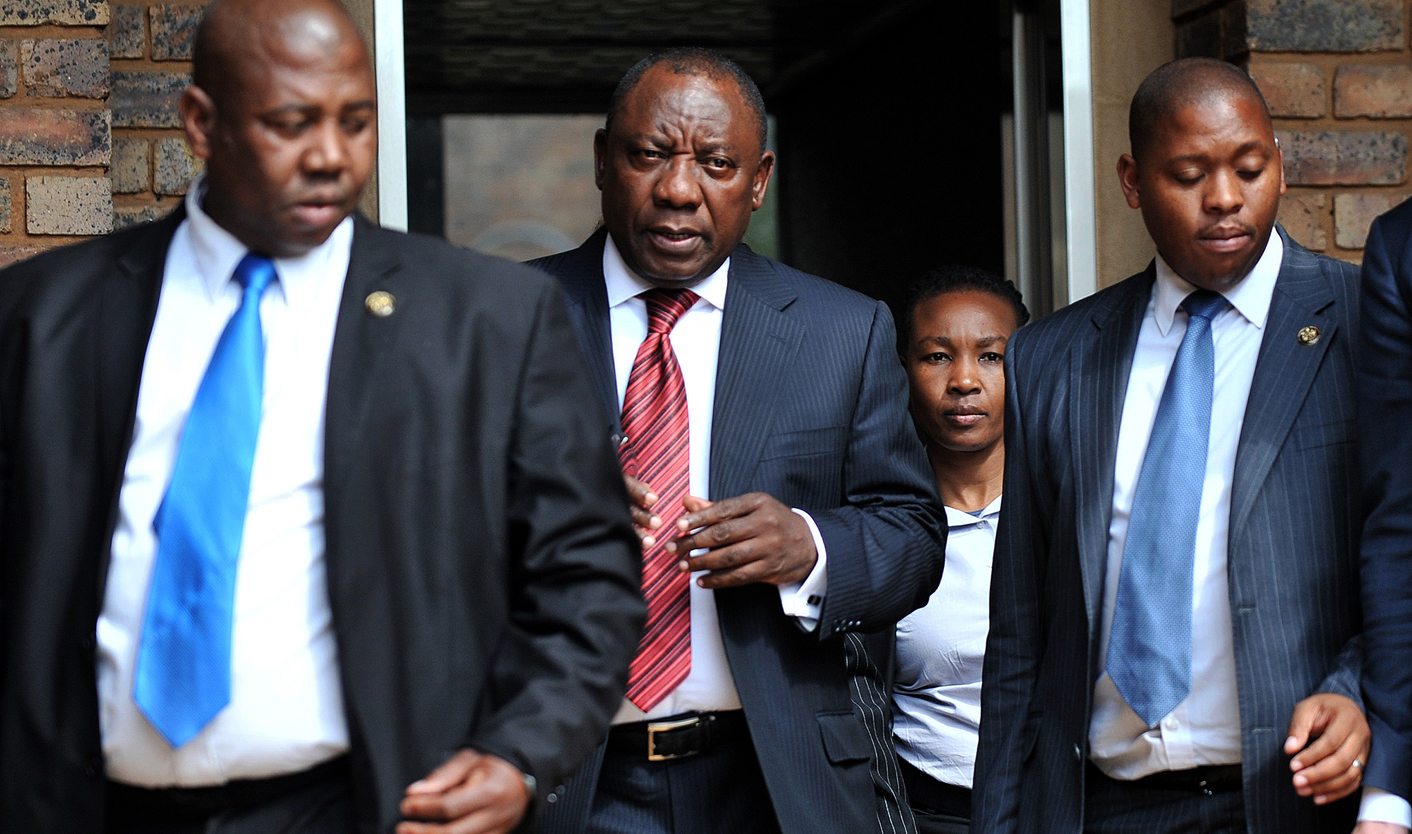
"contents": "<p>“Khau ba buze, ba thethe inyane,” hum the injured and arrested mineworkers as photographers huddle around the door waiting for Deputy President Cyril Ramaphosa. An Economic Freedom Fighters member hands out T-shirts with the visage of a buffalo’s head on it.</p>\r\n<p>“Buffalo!”</p>\r\n<p>“Buffalo head!” yells someone in the Commission, as Ramaphosa enters. He takes his oath and they don’t believe him.</p>\r\n<p>“He doesn’t believe in God,” says an activist.</p>\r\n<p>Ramaphosa was testifying at the inquiry into the deaths of 44 people in Marikana during the labour unrest of August 2012. At the time, he was a shareholder, non-executive director of Lonmin and chair of their transformation committee. He has since become the focus point for allegations that ANC politicians, its National Union of Mineworker (NUM) allies and Lonmin pressured the police to end the strike with force, pushing the SAPS to the brink of slaughtering 34 protestors on 16 August 2012.</p>\r\n<p>He sits in the Commission wearing a black suit, two-toned red tie, and white shirt with French cuffs and cufflinks. Behind him sits his wife, a seat between her and the bodyguards either side. Security has been increased for his appearance.</p>\r\n<p>Advocate David Unterhalter leads his evidence in chief. Ramaphosa puts on his glasses and chuckles as the throng of lawyers discuss exhibit numbers. He’s asked about the emails between himself and Lonmin and the contact he had with ministers Nathi Mthethwa, police, and Susan Shabangu, mineral resources. According to Dali Mpofu, representing the injured and arrested protesters, Ramaphosa was one layer in the conduit of pressure between management, politicians and police that led to killing protesters.</p>\r\n<p>Ramaphosa, however, describes his communication as benevolent. His Shanduka representative at Lonmin told him of the protests and killings. He relayed that to Mthethwa and Shabangu and set up a meeting with the NUM. It wasn’t a labour dispute but a criminal situation, he says, and he requested increased police presence to prevent further loss of life.</p>\r\n<p>Marikana was in large part due to the earlier protest in 2012 at Impala, where rock drill operators led a successful, if violent, strike, and when Ramaphosa saw what was happening at Lonmin he looked at what the workers were being paid. The differential compared with other companies was stark. The offer of a bonus wouldn’t solve the problem, he figured. But when things got violent, the situation changed, he says. First and foremost was safety; then they could discuss wages. The protest wasn’t a labour issue, it was a criminal one, he says, taking Lonmin’s line.</p>\r\n<p>“I felt duty-bound and had to help,” says Ramaphosa. “The way the people were being killed, the brutality thereof, I concluded this is a dastardly criminal acts. They are horrific. They are terrible and I couldn’t find a better way of describing it when someone is killed and their body parts are cut out of their bodies, some parts of their limbs are cut out; I couldn’t find any better way of describing it. To me it was quite horrific.”</p>\r\n<p>He tried to convince Shabangu to see the strike not as a labour dispute. He told Mthethwa his concerns. He “realised we were dealing with people bent on killing other people”. In an email to Lonmin’s acting head at the time, Albert Jamieson, he said, “They are plainly dastardly criminal[s] and must be characterised as such.” He called for “concomitant action”, “containing the situation” and to “act correctly”. All of those, he explains, are calls on the police to identify and arrest those who had killed to avoid further deaths.</p>\r\n<p>“No, I did not at any time seek to prescribe what kind of action [police] should take except what I saw as doing their duties.” Lonmin executives asked him to relay the info to government and he obliged. He had the phone numbers; they didn’t; Ramaphosa could do it. He did so to prevent further violence, he stresses, again and again.</p>\r\n<p>Cyril Ramaphosa was the prince who might save South Africa. He was instrumental in building NUM at a time when the Apartheid government was wary of the potential power of trade unions. He helped negotiate democracy, was there when the hallowed Constitution was drafted. When the transition threatened to fall apart, he was in the team that kept it on track. Famously, he was Nelson Mandela’s favourite to be the second president of democratic SA. It never happened. Instead, he became one of the country’s richest citizens and then returned to state politics as deputy to Jacob Zuma, a man who 20 years ago wasn’t in Ramaphosa’s league.</p>\r\n<p>“Buffalo prince,” laughs the EFF member. “He’s funny.” Ramaphosa is steadfast, laughs when he needs to, and never deviates from his stated position. The cross-examiners want to poke holes in his version.<em></em></p>\r\n<p><em><img loading=\"lazy\" src=\"//www.dailymaverick.co.za/images/resized_images/465x483q70greg-ramaphosa-McCyril.jpg\" border=\"0\" alt=\"greg-ramaphosa McCyril\" width=\"465\" height=\"483\" /></em><em></em></p>\r\n<p><em>Photo: A man seen with a T-shirts bearing the words \"McCyril the killer\" while attending the Farlam Commission of Inquiry in Centurion on Monday, 11 August 2014 where Deputy President Cyril Ramaphosa was testifying. Picture: SAPA stringer</em></p>\r\n<p>First is evidence leader Geoff Budlender. The workers didn’t trust the NUM, the union and employees have admitted that, yet Lonmin told them to drop their weapons and go through the recognised union? It wasn’t a board decision, says Ramaphosa, admitting that companies need to be flexible, do whatever they can to end a strike. AMCU was consulted as an afterthought, only at the last minute, and then they were basically told to <em>tsek.</em></p>\r\n<p>The allegations of political influence are linked to NUM. In the infamous transcript between Lonmin vice president for human resources Bernard Mokoena and North West Provincial Police Commissioner Zukiswa Mbombo, the two reference the need not to sideline the NUM and avoid Julius Malema gaining traction in the area.</p>\r\n<p>Ramaphosa clasps his hands on the table, as if in prayer. No, it’s not right to favour one union over another and organise police on that basis. No, Malema can’t be a motive for taking a specific response to a strike.</p>\r\n<p>Second is Tembeka Ngcukaitobi from the Legal Resources Centre, representing some family members of the victims. He points out Ramaphosa’s indirect contribution to the unrest. As chair of Lonmin’s transformation committee, Ramaphosa was tasked with monitoring the company’s social development plans and during his tenure had told the media that unrest was largely due to the legacy of the migrant labour system and inhumane living conditions of miners. Yet in 2011 he seemed to accept that Lonmin had abandoned a five-year plan to build 5,500 houses for miners because of financial pressures created by the global financial crisis. The company, meanwhile, only built three of the planned homes, show units, despite the boom years before the financial crisis hit. The issues are more complex than presented at the Commission, but the effect was that Ramaphosa, through Lonmin’s failure, is indirectly responsible for what happened and has failed in his role as a former representative of workers.</p>\r\n<p>“I would categorise that as a success. I would categorise that as a work in progress,” says Ramaphosa.</p>\r\n<p>“He’s lying,” a voice from the audience shouts. Minutes later, a protest erupts.</p>\r\n<p>“Ramaphosa has blood on his hands,” yells a leader of the Democratic Left Front. “Blood on his hands, blood on his hands,” others join in.</p>\r\n<p>“Buffalo, buffalo, buffalo…”</p>\r\n<p>Commission chairman Ian Farlam walks out. Bodyguards move to flank Ramaphosa. Mpofu asks the protestors to let the Commission resume.</p>\r\n<p>“As long as he knows he has blood on his hands,” yells one. “He’s a sell-out, this man. He sold out the revolution.” Ramaphosa stands nonplussed, picking at his teeth.</p>\r\n<p>Dumisa Ntsebeza, representing the families of the killed mineworkers, is next to take a shot at Ramaphosa. He makes a few clear points. Ramaphosa, the unionist, should have known calling for police action, the continued and increased presence of hundreds of officers, would have caused more violence, especially after two officers were killed on 13 August. Yet he called for more. He’s evasive in his answer. Lonmin executives’ push to characterise the strike as criminal, which Ramaphosa was tasked to convince ministers Mthethwa and Shabangu of, looks like an attempt to break the strike with force so Lonmin wouldn’t have to negotiate. Jamieson linked the police response to resuming work; it’s hard to see it any other way, and Ramaphosa was the perfect conduit. He was only trying to save lives, he says.</p>\r\n<p class=\"arcticletext\">Ntsebeza says, “It really goes without saying, you are a skilled negotiator, you are a skilled mediator, you are a strategist.” Ramaphosa plays it down. The deputy president says he was only in the position to relay information and couldn’t have done anything more as a non-executive director. “This was what one could call a perfect storm that had evolved. AMCU was saying they are not involved so, in a way, abdicated. The CEO of Lonmin had taken ill and was not on the spot to negotiate. NUM itself was not really involved. We have heard that the workers had lost confidence in the NUM. As a non-executive director, not involved in the management of the company, I relied on the management team to deal with these matters.”</p>\r\n<p>Ntsebeza finished by criticising Ramaphosa’s commitment to black economic empowerment. Despite his former position as a BEE Commission chair, he has an all-white legal team.</p>\r\n<p>The Commission laughs.</p>\r\n<p>“Oh, are we done?” asks Ramaphosa.</p>\r\n<p>He will be back on Tuesday. On Monday, he remained resolute despite being called a murderer and being questioned on acting on both his political and business bias. There are a few takeaways from the day. Ramaphosa was biased towards the NUM and Lonmin. He acted in their favour. He never thought of intervening as he could have, given his knowledge of labour disputes, his links to all the parties and his negotiating skills. Instead he perpetuated and constructed the idea that the strike was only criminal, ignoring the aspects of labour relations that ultimately ended the strike.</p>\r\n<p>On Tuesday, Dali Mpofu, representing the injured and arrested mineworkers, will argue that Ramaphosa’s bias, his allegiance to who he was serving, was fatal. It was the pressure that seeped down through the state to the police, angry at the death of their colleagues, promoted and legitimised the enacting of a terrible plan with terrible timing, and led the police to kill mineworkers in cold blood.</p>\r\n<p>“Buffalo head, buffalo head,” protestors chant as Ramaphosa’s convey prepare to leave. “Cyril’s a dog, Cyril’s a dog.” <strong><span style=\"text-decoration: underline;\">DM</span></strong><em></em></p>\r\n<p><em>Photo: </em><em>Deputy President Cyril Ramaphosa (surrounded by bodyguards) seen at the Farlam Commission of Inquiry in Centurion, Pretoria on Monday, 11 August 2014 where he was testifying. Picture: SAPA stringer</em></p>",
"teaser": "The Buffalo Prince and the Marikana Commission",
"externalUrl": "",
"sponsor": null,
"authors": [
{
"id": "96",
"name": "Greg Nicolson",
"image": "http://local.dailymaverick.co.za/wp-content/uploads/5c6a775667c42894e469febf08f3321d.jpg",
"url": "https://staging.dailymaverick.co.za/author/gregnicolson/",
"editorialName": "gregnicolson",
"department": "",
"name_latin": ""
}
],
"description": "",
"keywords": [
{
"type": "Keyword",
"data": {
"keywordId": "2735",
"name": "Government of South Africa",
"url": "https://staging.dailymaverick.co.za/keyword/government-of-south-africa/",
"slug": "government-of-south-africa",
"description": "",
"articlesCount": 0,
"replacedWith": null,
"display_name": "Government of South Africa",
"translations": null
}
},
{
"type": "Keyword",
"data": {
"keywordId": "2736",
"name": "Politics of South Africa",
"url": "https://staging.dailymaverick.co.za/keyword/politics-of-south-africa/",
"slug": "politics-of-south-africa",
"description": "",
"articlesCount": 0,
"replacedWith": null,
"display_name": "Politics of South Africa",
"translations": null
}
},
{
"type": "Keyword",
"data": {
"keywordId": "2745",
"name": "Cyril Ramaphosa",
"url": "https://staging.dailymaverick.co.za/keyword/cyril-ramaphosa/",
"slug": "cyril-ramaphosa",
"description": "Matamela Cyril Ramaphosa is the fifth and current president of South Africa, in office since 2018. He is also the president of the African National Congress (ANC), the ruling party in South Africa. Ramaphosa is a former trade union leader, businessman, and anti-apartheid activist.\r\n\r\nCyril Ramaphosa was born in Soweto, South Africa, in 1952. He studied law at the University of the Witwatersrand and worked as a trade union lawyer in the 1970s and 1980s. He was one of the founders of the National Union of Mineworkers (NUM), and served as its general secretary from 1982 to 1991.\r\n\r\nRamaphosa was a leading figure in the negotiations that led to the end of apartheid in South Africa. He was a member of the ANC's negotiating team, and played a key role in drafting the country's new constitution. After the first democratic elections in 1994, Ramaphosa was appointed as the country's first trade and industry minister.\r\n\r\nIn 1996, Ramaphosa left government to pursue a career in business. He founded the Shanduka Group, a diversified investment company, and served as its chairman until 2012. Ramaphosa was also a non-executive director of several major South African companies, including Standard Bank and MTN.\r\n\r\nIn 2012, Ramaphosa returned to politics and was elected as deputy president of the ANC. He was elected president of the ANC in 2017, and became president of South Africa in 2018.\r\n\r\nCyril Ramaphosa is a popular figure in South Africa. He is seen as a moderate and pragmatic leader who is committed to improving the lives of all South Africans. He has pledged to address the country's high levels of poverty, unemployment, and inequality. He has also promised to fight corruption and to restore trust in the government.\r\n\r\nRamaphosa faces a number of challenges as president of South Africa. The country is still recovering from the legacy of apartheid, and there are deep divisions along racial, economic, and political lines. The economy is also struggling, and unemployment is high. Ramaphosa will need to find a way to unite the country and to address its economic challenges if he is to be successful as president.",
"articlesCount": 0,
"replacedWith": null,
"display_name": "Cyril Ramaphosa",
"translations": null
}
},
{
"type": "Keyword",
"data": {
"keywordId": "2746",
"name": "African National Congress",
"url": "https://staging.dailymaverick.co.za/keyword/african-national-congress/",
"slug": "african-national-congress",
"description": "The African National Congress (ANC) is a social-democratic political party in South Africa. It has been the governing party of South Africa since the 1994 general election. It was the first election in which all races were allowed to vote.\r\n\r\nThe ANC is the oldest political party in South Africa, founded in 1912. It is also the largest political party in South Africa, with over 3 million members.\r\n\r\nThe African National Congress is a liberation movement that fought against apartheid, a system of racial segregation that existed in South Africa from 1948 to 1994. The ANC was banned by the South African government for many years, but it continued to operate underground.\r\n\r\nIn 1990, the ban on the ANC was lifted and Nelson Mandela was released from prison. The ANC then negotiated a peaceful transition to democracy in South Africa.\r\n\r\nSince 1994, the ANC has governed South Africa under a system of majority rule.\r\n\r\nThe African National Congress has been criticised for corruption and for failing to address some of the challenges facing South Africa, such as poverty and unemployment.\r\n\r\nThe African National Congress is a complex and diverse organisation. It is a coalition of different political factions, including communists, socialists, and trade unionists.\r\n\r\nThe ANC has always claimed to be a broad church that includes people from all walks of life. It is a powerful force in South African politics and it will continue to play a major role in the country's future.\r\n\r\nThe party's support has declined over the years and it currently faces a threat of losing control of government in the 2024 national elections.",
"articlesCount": 0,
"replacedWith": null,
"display_name": "African National Congress",
"translations": null
}
},
{
"type": "Keyword",
"data": {
"keywordId": "2747",
"name": "Politics",
"url": "https://staging.dailymaverick.co.za/keyword/politics/",
"slug": "politics",
"description": "",
"articlesCount": 0,
"replacedWith": null,
"display_name": "Politics",
"translations": null
}
},
{
"type": "Keyword",
"data": {
"keywordId": "2751",
"name": "Economic Freedom Fighters",
"url": "https://staging.dailymaverick.co.za/keyword/economic-freedom-fighters/",
"slug": "economic-freedom-fighters",
"description": "",
"articlesCount": 0,
"replacedWith": null,
"display_name": "Economic Freedom Fighters",
"translations": null
}
},
{
"type": "Keyword",
"data": {
"keywordId": "3706",
"name": "Susan Shabangu",
"url": "https://staging.dailymaverick.co.za/keyword/susan-shabangu/",
"slug": "susan-shabangu",
"description": "",
"articlesCount": 0,
"replacedWith": null,
"display_name": "Susan Shabangu",
"translations": null
}
},
{
"type": "Keyword",
"data": {
"keywordId": "4938",
"name": "Mining in South Africa",
"url": "https://staging.dailymaverick.co.za/keyword/mining-in-south-africa/",
"slug": "mining-in-south-africa",
"description": "",
"articlesCount": 0,
"replacedWith": null,
"display_name": "Mining in South Africa",
"translations": null
}
},
{
"type": "Keyword",
"data": {
"keywordId": "5946",
"name": "Lonmin",
"url": "https://staging.dailymaverick.co.za/keyword/lonmin/",
"slug": "lonmin",
"description": "",
"articlesCount": 0,
"replacedWith": null,
"display_name": "Lonmin",
"translations": null
}
},
{
"type": "Keyword",
"data": {
"keywordId": "8083",
"name": "Mthethwa",
"url": "https://staging.dailymaverick.co.za/keyword/mthethwa/",
"slug": "mthethwa",
"description": "",
"articlesCount": 0,
"replacedWith": null,
"display_name": "Mthethwa",
"translations": null
}
},
{
"type": "Keyword",
"data": {
"keywordId": "8820",
"name": "Dali Mpofu",
"url": "https://staging.dailymaverick.co.za/keyword/dali-mpofu/",
"slug": "dali-mpofu",
"description": "Dali Mpofu is a South African lawyer, politician, and former businessman. He was the National Chairperson of the Economic Freedom Fighters (EFF) from 2014 to 2019.\r\n\r\nHe served on the Judicial Service Commission from 2017 to 2022 and formerly served as chief executive officer of the South African Broadcasting Corporation from 2005 to 2009.\r\n\r\nMpofu was born in East London, Eastern Cape, South Africa, in 1962. He studied law at the University of the Witwatersrand, graduating with an LLB degree in 1988. After graduating, he worked as a lawyer in private practice. He also served as the National Legal Advisor of the Congress of South African Trade Unions (COSATU) from 1992 to 1994.\r\n\r\nIn 2009, Dali Mpofu was appointed as the Minister of Justice and Constitutional Development in the Cabinet of President Jacob Zuma. He served in this position until 2012, when he was dismissed by Zuma.\r\n\r\nMpofu was a founding member of the EFF in 2013. He was elected as the National Chairperson of the party in 2014. He served in this position until 2019, when he was replaced by Floyd Shivambu.\r\n\r\nDali Mpofu is a controversial figure. He has been criticized for his handling of a Section 189 hearing as the representative of the suspended Public Protector, Busisiwe Mkhwebane. He has drawn criticism for his outspoken views on a range of issues.\r\n\r\nHowever, he is also a respected lawyer and politician. He is a skilled advocate and a formidable debater.\r\n\r\nMpofu is married to Mpumi Nxumalo. They have four children.",
"articlesCount": 0,
"replacedWith": null,
"display_name": "Dali Mpofu",
"translations": null
}
},
{
"type": "Keyword",
"data": {
"keywordId": "18460",
"name": "buffalo",
"url": "https://staging.dailymaverick.co.za/keyword/buffalo/",
"slug": "buffalo",
"description": "",
"articlesCount": 0,
"replacedWith": null,
"display_name": "buffalo",
"translations": null
}
}
],
"short_summary": null,
"source": null,
"related": [],
"options": [],
"attachments": [
{
"id": "111144",
"name": "",
"description": "",
"focal": "50% 50%",
"width": 0,
"height": 0,
"url": "https://dmcdn.whitebeard.net/dailymaverick/wp-content/uploads/greg-ramaphosa-Marikana-commission-MAIN.jpg",
"transforms": [
{
"x": "200",
"y": "100",
"url": "https://dmcdn.whitebeard.net/i/HaTJhIc2HAkrR6epGMF_7ma0iKs=/200x100/smart/filters:strip_exif()/file/dailymaverick/wp-content/uploads/greg-ramaphosa-Marikana-commission-MAIN.jpg"
},
{
"x": "450",
"y": "0",
"url": "https://dmcdn.whitebeard.net/i/-xrIw9HeqocQwOgU0Fz3vNr11mA=/450x0/smart/file/dailymaverick/wp-content/uploads/greg-ramaphosa-Marikana-commission-MAIN.jpg"
},
{
"x": "800",
"y": "0",
"url": "https://dmcdn.whitebeard.net/i/RZ107qc1u7FlseOwdXRnnd4OBRo=/800x0/smart/filters:strip_exif()/file/dailymaverick/wp-content/uploads/greg-ramaphosa-Marikana-commission-MAIN.jpg"
},
{
"x": "1200",
"y": "0",
"url": "https://dmcdn.whitebeard.net/i/gVxUQs34FHZo-3fKcqZCfC04fTc=/1200x0/smart/filters:strip_exif()/file/dailymaverick/wp-content/uploads/greg-ramaphosa-Marikana-commission-MAIN.jpg"
},
{
"x": "1600",
"y": "0",
"url": "https://dmcdn.whitebeard.net/i/ltZGygSAMW6FXqtgf6BsMxgWl7c=/1600x0/smart/filters:strip_exif()/file/dailymaverick/wp-content/uploads/greg-ramaphosa-Marikana-commission-MAIN.jpg"
}
],
"url_thumbnail": "https://dmcdn.whitebeard.net/i/HaTJhIc2HAkrR6epGMF_7ma0iKs=/200x100/smart/filters:strip_exif()/file/dailymaverick/wp-content/uploads/greg-ramaphosa-Marikana-commission-MAIN.jpg",
"url_medium": "https://dmcdn.whitebeard.net/i/-xrIw9HeqocQwOgU0Fz3vNr11mA=/450x0/smart/file/dailymaverick/wp-content/uploads/greg-ramaphosa-Marikana-commission-MAIN.jpg",
"url_large": "https://dmcdn.whitebeard.net/i/RZ107qc1u7FlseOwdXRnnd4OBRo=/800x0/smart/filters:strip_exif()/file/dailymaverick/wp-content/uploads/greg-ramaphosa-Marikana-commission-MAIN.jpg",
"url_xl": "https://dmcdn.whitebeard.net/i/gVxUQs34FHZo-3fKcqZCfC04fTc=/1200x0/smart/filters:strip_exif()/file/dailymaverick/wp-content/uploads/greg-ramaphosa-Marikana-commission-MAIN.jpg",
"url_xxl": "https://dmcdn.whitebeard.net/i/ltZGygSAMW6FXqtgf6BsMxgWl7c=/1600x0/smart/filters:strip_exif()/file/dailymaverick/wp-content/uploads/greg-ramaphosa-Marikana-commission-MAIN.jpg",
"type": "image"
}
],
"summary": "Two years ago on Monday, Lonmin workers marched on the NUM and were fired upon by union members, starting a spiral of violence that ended in the Marikana massacre. On Monday, NUM founding general secretary and current Deputy President Cyril Ramaphosa testified on his role in the murky collaboration between Lonmin and politicians. The 'buffalo prince' survived, steadfast and resolute, but human after all. By GREG NICOLSON.",
"template_type": null,
"dm_custom_section_label": null,
"elements": [],
"seo": {
"search_title": "The Buffalo Prince and the Marikana Commission",
"search_description": "<p>“Khau ba buze, ba thethe inyane,” hum the injured and arrested mineworkers as photographers huddle around the door waiting for Deputy President Cyril Ramaphosa. An Economic Freedom Fighters member ",
"social_title": "The Buffalo Prince and the Marikana Commission",
"social_description": "<p>“Khau ba buze, ba thethe inyane,” hum the injured and arrested mineworkers as photographers huddle around the door waiting for Deputy President Cyril Ramaphosa. An Economic Freedom Fighters member ",
"social_image": ""
},
"cached": true,
"access_allowed": true
}